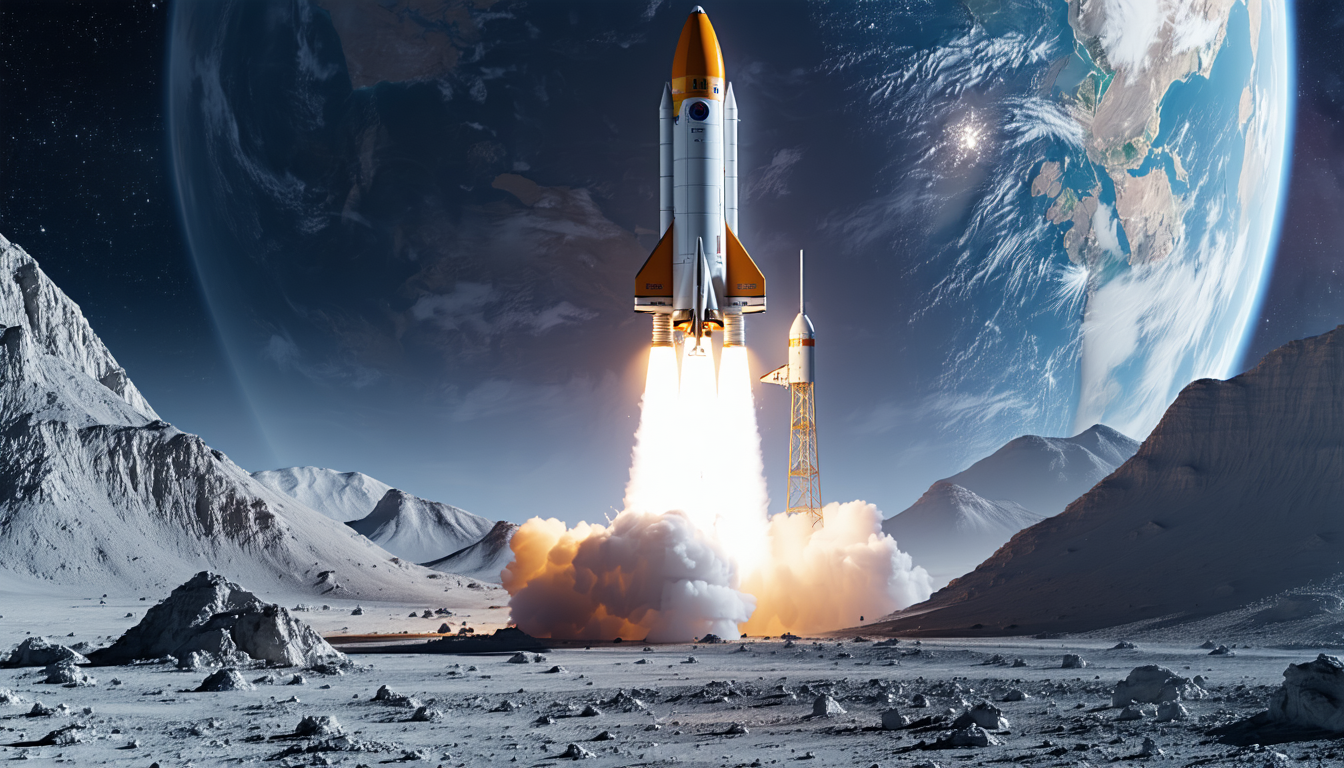
The year 2025 marks a pivotal moment in humanity's journey to the stars. From ambitious Mars missions to revolutionary lunar programs and groundbreaking private space ventures, this year is set to redefine our relationship with the cosmos.
Mars Mission Milestones
NASA's Artemis program continues to make headlines as preparations for the first crewed Mars mission intensify. The latest developments include successful testing of the new life support systems and advanced radiation shielding technologies that will protect astronauts during the seven-month journey to the Red Planet.
International Collaboration
The European Space Agency (ESA) and China's National Space Administration (CNSA) have announced a joint mission to establish a research station on Phobos, Mars' largest moon. This unprecedented collaboration represents a new era of international cooperation in space exploration.
Lunar Development Programs
The Moon is experiencing a renaissance of interest, with multiple nations and private companies racing to establish permanent lunar bases. NASA's Artemis Base Camp is scheduled to begin construction in late 2025, featuring:
- Habitat modules capable of supporting up to 12 astronauts
- In-situ resource utilization (ISRU) facilities for water extraction
- Solar power arrays and nuclear reactors for reliable energy
- Communications infrastructure for Earth-Moon connectivity
Private Sector Innovation
SpaceX's Starship has completed its first successful lunar cargo delivery, transporting essential supplies and construction materials for the upcoming base. Blue Origin's Blue Moon lander has also achieved certification for crewed missions, expanding options for lunar access.
Private Space Ventures Taking Flight
The commercial space industry is booming, with several companies making significant strides:
Space Tourism Expansion
Virgin Galactic has successfully completed over 200 commercial space tourism flights, while Blue Origin's New Shepard has carried more than 500 private passengers to the edge of space. Ticket prices have begun to decrease as operations scale up, making space more accessible to a broader audience.
Satellite Mega-Constellations
SpaceX's Starlink network has surpassed 10,000 active satellites, providing high-speed internet to even the most remote corners of Earth. Competitors including Amazon's Project Kuiper and OneWeb are rapidly expanding their own constellations, promising global connectivity like never before.
Scientific Discoveries
The James Webb Space Telescope continues to revolutionize our understanding of the universe, with recent discoveries including:
- Detailed atmospheric analysis of potentially habitable exoplanets
- Unprecedented images of galaxies from the early universe
- Detection of organic molecules in distant star systems
- New insights into dark matter distribution
Technological Innovations
Propulsion Systems
Revolutionary ion drive technologies are being tested on deep space probes, promising to reduce travel time to outer planets by up to 40%. Nuclear thermal propulsion systems are also showing promise for future Mars missions.
AI and Robotics
Advanced AI systems are now capable of autonomous spacecraft operation, reducing the need for constant ground control and enabling more complex missions. Robotic systems are being deployed for lunar and Martian surface exploration, paving the way for human settlements.
Challenges and Future Outlook
Despite remarkable progress, space exploration faces ongoing challenges including:
- Radiation exposure during long-duration space travel
- Psychological effects of isolation on astronauts
- Space debris management in increasingly crowded orbits
- Sustainable funding for long-term missions
However, the momentum is undeniable. With continued investment, international cooperation, and technological innovation, 2025 stands as a landmark year that will be remembered as a turning point in humanity's expansion beyond Earth.